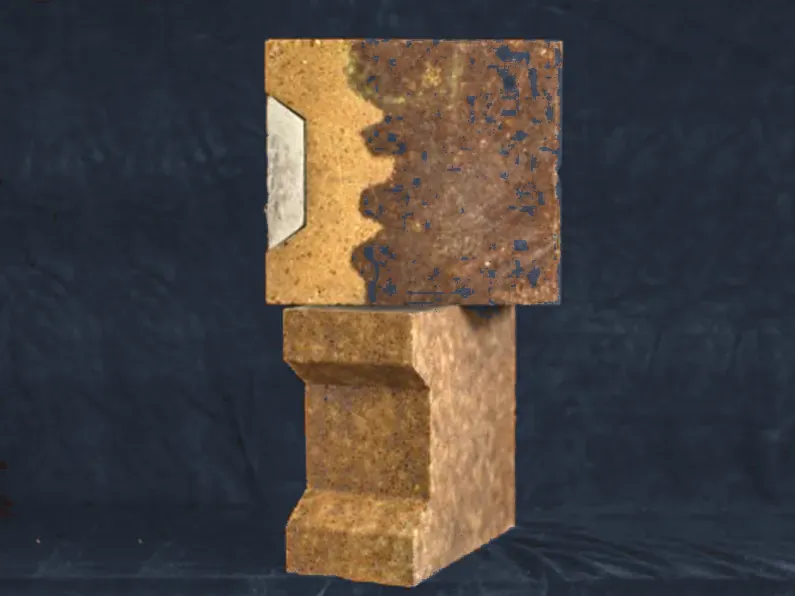
Corundum Series
JX-SN Special Corundum Composite Brick
A chrome-free corundum-based composite brick (Al₂O₃ ≈ 72 %, BD 2.91 g/cm³, RUL T0.6 1696 ℃ in a 2019 third-party test) for transition and high-temperature zones of rotary kilns.
- 1696
- Refractoriness under load (RUL) · ℃
- 2.91
- Bulk density · g/cm³
- 133
- Cold crushing strength · MPa
Measured by a third-party lab in 2019; typical values, not guaranteed
Overview
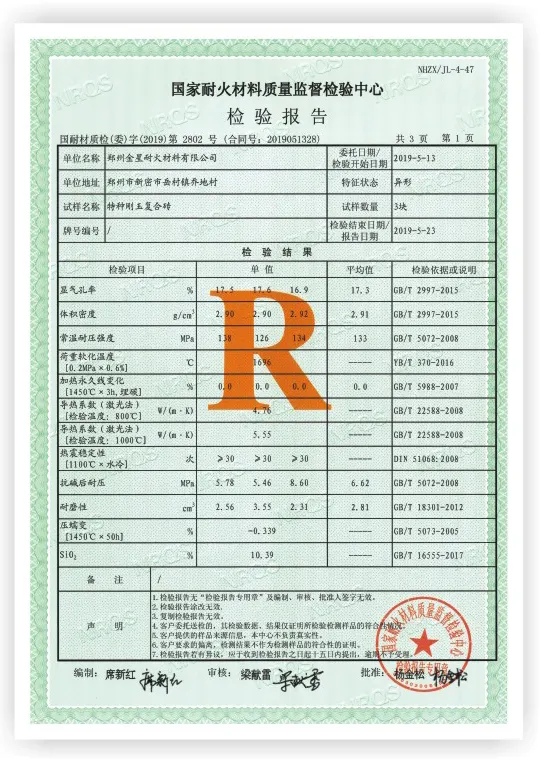
JX-SN is a chrome-free corundum-based composite brick developed by Jinxing for high-temperature zones of rotary kilns. The table lists the results of a 2019 third-party test (National Quality Supervision & Inspection Center for Refractory Materials, report No. 20192802, three shaped samples).
Applications
- Transition zones of cement rotary kilns
- High-temperature zones of lime and magnesium-metal rotary kilns
- High-temperature, corrosive areas of metallurgical and chemical furnaces
Technical data
| Property | Condition | Unit | Test method | Typical |
|---|---|---|---|---|
| Fe₂O₃★ | — | % | GB/T 16555-2017 | 0.50 |
| SiO₂ | — | % | GB/T 16555-2017 | 10.39 |
| Bulk density★ | — | g/cm³ | GB/T 2997-2015 | 2.91 (2.90/2.90/2.92) |
| Apparent porosity★ | — | % | GB/T 2997-2015 | 17.3 (17.5/17.6/16.9) |
| Cold crushing strength★ | — | MPa | GB/T 5072-2008 | 133 (138/126/134) |
| Refractoriness under load (RUL)★ | 0.2 MPa, 0.6 % deformation (T0.6) | ℃ | YB/T 370-2016 | 1696 |
| Permanent linear change (PLC)★ | 1450 ℃ × 3 h, carbon-embedded | % | GB/T 5988-2007 | 0.0 (0.0/0.0/0.0) |
| Thermal shock resistance★ | 1100 ℃, water quenching | cycles | DIN 51068:2008 | ≥30 |
| Cold abrasion loss | — | cm³ | GB/T 18301-2012 | 2.81 (2.56/3.55/2.31) |
| Creep in compression | 1450 ℃ × 50 h | % | GB/T 5073-2005 | -0.339 |
| Thermal conductivity | Laser flash, 800 ℃ / 1000 ℃ | W/(m·K) | GB/T 22588-2008 | 4.76 (800 ℃); 5.55 (1000 ℃) |
| CCS after alkali test | After alkali test | MPa | GB/T 5072-2008 | 6.62 (5.78/5.46/8.60) |
Typical values, subject to test report.
Typical values are for reference only; actual values are subject to the inspection report of each batch. Test methods as listed.
★ Key property for this material class.
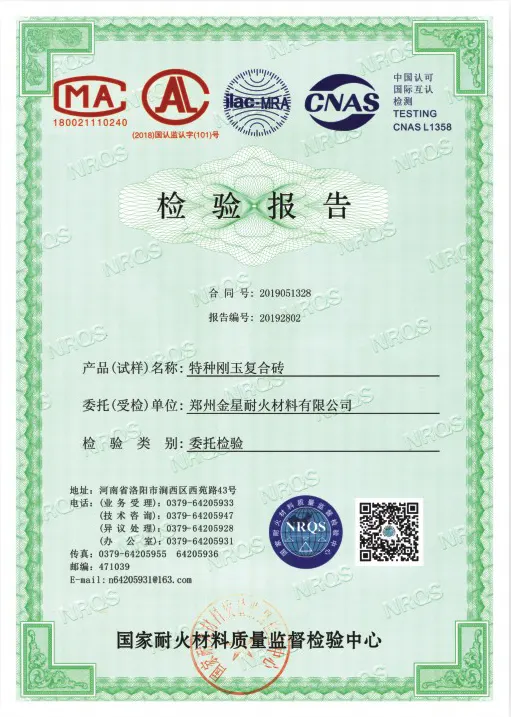
Third-party test report
National Quality Supervision & Inspection Center for Refractory Materials (Luoyang, CMA 180021110240 / CNAS L1358), test report No. 20192802, dated 2019-05-23. Entrusted test on three shaped samples submitted by Jinxing (individual results in brackets); valid for the submitted samples only.
Related products
Special Corundum-Mullite Composite Brick
A corundum-mullite brick (Al₂O₃ ≥ 80 %) with RUL ≥ 1700 ℃ for high-temperature and transition zones of lime, magnesium-metal and bauxite rotary kilns; an insulating triple-layer version is offered on request.
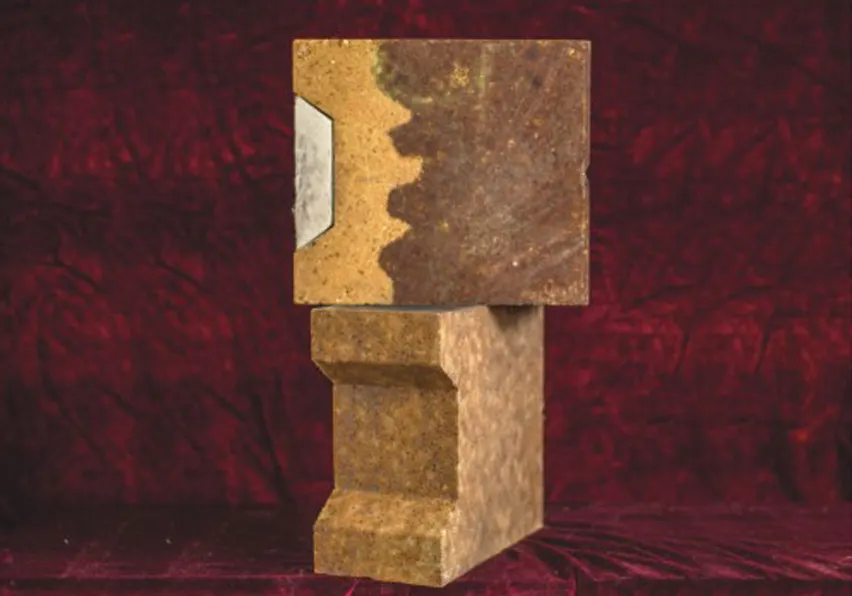
Corundum–Silica-Mullite Composite Brick (for lime & magnesium rotary kilns)
A corundum / silica-mullite composite brick combining wear resistance with lower heat loss for burning zones of lime and magnesium-metal rotary kilns.
Si-Zr Corundum-Mullite Composite Brick
A zirconia-containing corundum-mullite composite brick for burning zones of lime, magnesium-metal and bauxite rotary kilns.
FAQ
Why do RUL values appear as T0.5 or T0.6?
They come from different methods: YB/T 370 (non-differential) reports T0.6, GB/T 5989 / ISO 1893 (differential) reports T0.5, and the two cannot be converted. Jinxing's current data are reported at 0.2 MPa / 0.6 % deformation (T0.6).
Are the data-sheet values guaranteed?
Unless marked "Spec", values are typical and for reference only; each shipment is supplied with its own inspection report.
How do I choose between silica-mullite, phosphate-bonded and corundum composite bricks?
It depends on the dominant wear mechanism in each zone (temperature, chemical attack, abrasion). Silica-mullite and phosphate-bonded wear-resistant bricks are typically used in transition, cooling and medium-temperature wear zones; corundum-based products are used where temperature and slag attack are severe. Send us your kiln data and our engineers will propose a zone-by-zone design.
Ask about this product
Tell us the kiln, zone, brick shapes and quantity. We reply within 1 business day.